


Structural formula: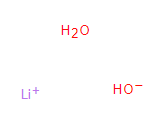
Product Specification:
| Index | Lithium hydroxide monohydrate | |
| Appearance requirements | white powder crystal | |
| LiOH ≥(%) | 56.5% | |
| Impurity≤(%) | Na +K | 0.20 |
| Fe | 0.002 | |
| CaO2 | 0.033 | |
| HCl insoluble | 0.01 | |
| Cl | 0.02 | |
| SO4 | 0.03 | |
| CO2 | 0.5 | |
Lithium Hydroxide Monohydrate CAS 1310-66-3 is a white crystalline powder with strong alkaline properties. Its main applications include grease additives, lithium battery raw materials, analytical reagents, photographic developers and raw materials for preparing other lithium compounds.
As a grease additive, lithium hydroxide can improve the heat resistance, water resistance and stability of mechanical equipment such as bearings, thereby extending their service life, and is used in many neutral equipment.
At the same time, as the electrolyte raw material for lithium batteries, lithium hydroxide is also an indispensable part of the modern battery industry. Its excellent performance enables lithium batteries to have higher energy density and longer service life.
Among photographic developers, lithium hydroxide plays an important role in helping to produce clear images.
Lithium Hydroxide Monohydrate Applications
Lithium Grease Production
Lithium Hydroxide Monohydrate is used to produce lithium soaps for lubricating grease. It reacts with fatty acids, including 12-hydroxystearic acid, to form the thickener structure in lithium-based grease.
Lithium Compounds and Chemical Synthesis
LiHO.H2O is a starting material for producing other lithium salts and specialty lithium compounds. It is also used as a strong inorganic base in neutralization, esterification and selected catalyst-production processes.
Battery Cathode Materials
Battery-grade Lithium Hydroxide Monohydrate is used as a lithium source in the production of nickel-rich cathode materials, including selected NCM and NCA materials.
Ceramics and Glass
Lithium Hydroxide Monohydrate is used as a lithium source in specialty ceramics, glass and glaze formulations. Lithium can help adjust firing behavior, thermal properties and the performance of the finished ceramic or glass composition.
Cement and Construction Materials
Lithium Hydroxide Monohydrate can be used as a setting accelerator in calcium aluminate cement systems. It is also evaluated in lithium-based treatments intended to control alkali–silica reaction in concrete.
Coolants and Corrosion-Control Formulations
Lithium Hydroxide Monohydrate can be used to adjust alkalinity in selected industrial coolant and corrosion-control systems. It helps maintain the required alkaline environment when used with a suitable inhibitor package.
Compatibility with aluminium, zinc and tin must be checked because concentrated Lithium Hydroxide solutions can attack these metals and release hydrogen.
Carbon Dioxide Removal
Lithium Hydroxide reacts with carbon dioxide to form lithium carbonate. This property supports its use in specialized carbon dioxide absorption systems.
Packaging and Storage
Packaging: 25kg/bag, 250kg/ton bag, or customized according to customer needs. Crushed products generally do not exceed 350kg/ton bag, and uncrushed products generally do not exceed 500kg/ton bag.
Storage: Store Lithium Hydroxide Monohydrate in a dry, well-ventilated area. Keep the original packaging tightly closed and place bags on pallets away from floors and walls.
Protect the product from moisture and carbon dioxide in the air. Opened bags should be resealed immediately because air exposure can increase carbonate content and change the effective LiOH assay.


 English
 日本語
 한국어
 Español
 Русский
 Italiano
 Türkçe