


Foconsci’s Diisooctylphosphinic acid (Cyanex 272) is an acidic organophosphorus extractant mainly used to separate cobalt from nickel in hydrometallurgical processes.
Fórmula estructural:
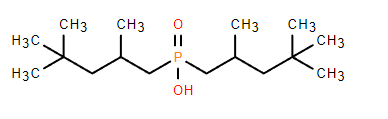
- Core Uses:Cobalt-nickel separation extractant for hydrometallurgy. Cyanex 272 selectively extracts cobalt from acidic leachate to achieve efficient Co/Ni separation for the production of high-purity cobalt salts and metallic cobalt. It can also be applied in extraction and recovery of other non-ferrous metals.
- Ventajas:High selectivity, good phase separation, low water solubility and excellent chemical stability.
View more Foconsci’s Metal Extraction Products Series


Especificación del producto
| Artículo | Especificación |
| Ácido diisooctilfosfínico | ≥95% |
| Apariencia | Líquido incoloro a amarillo claro |
| Solubility in H2O (Ph=3) | ≤21 mg / L |
| Punto de inflamabilidad | ≥190 °C |
| Punto de ebullición | ≥300 °C |
| Punto de congelación | ≤-32 °C |
| Densidad | 0.91-0.94 (20 ℃, g/cm³) |
| Viscosidad | ≤142 (25 ℃, mm²/s) |
Applications of Diisooctylphosphinic acid (Cyanex 272)
Separación de cobalto y níquel: Diisooctylphosphinic acid selectively extracts cobalt from solutions containing nickel. Cyanex 272 is used in cobalt refining to separate the two metals and prepare higher-purity cobalt solutions.
Lithium-Ion Battery Recycling: After spent NCM and other cobalt-containing battery materials are leached, Cyanex 272 can separate cobalt from nickel-containing sulfate solutions. The loaded organic phase can then be stripped to recover cobalt for further refining.
Cobalt Hydrometallurgy: Cyanex 272 extractant can treat cobalt-bearing sulfate and chloride liquors from ores, concentrates and secondary metal materials.
Rare-Earth and Other Metal Separation: Diisooctylphosphinic acid can also extract selected rare-earth and metal ions such as Ga, In, Mo, Ge, and Zr.


Comparison of Co/Ni Separation Extractants: Cyanex 272 vs. P507 vs. P204
Compared to P507 and P204, Cyanex 272 exhibits higher selectivity:
- P204 (D2EHPA) has the strongest acidity. It usually starts to extract Co at a lower pH value. But it also extracts Ni more easily at the same time. So its Co/Ni selectivity is relatively low.
- P507 (HEHEHP / PC-88A) sits in the middle. It is less acidic than P204. It co-extracts less Ni. So its Co/Ni separation performance is much better than P204. However, its selectivity for Co and Ni is still not as good as Cyanex 272.
- Cyanex 272 has the weakest acidity. It needs a relatively higher pH to extract Co effectively. Within a suitable pH range, Co can be well extracted, while most Ni stays in the aqueous phase. Therefore, it has the highest Co/Ni separation selectivity.
| Extractante | Separation Coefficient (βCo/Ni) |
| Cyanex 272 | 7000 |
| P507 (HEHEHP / PC-88A) | 280 |
| P204 (D2EHPA) | 14 |


 English
 日本語
 한국어
 Español
 Русский
 Italiano
 Türkçe